Contents: About the Collection | About the About Page | Tech
About the Collection
This study was done to see if there is a correlation between political alignment and hate crime statistics. I chose this project because the amount of political radicalizatin in the U.S. has dramatically increased over the last 10 years, and I wanted to see how often that political radicalization turns into violence by tracking hate crime data. This collection was created to provide samples from hate crime cases from 2014-2024. The collection contains the following:
- a CSV of collection metadata
- Images related to previous hate crime cases such as mugshots and vandalism related to hate crimes.
The Research Process
Tracking Hate Crime Statistics
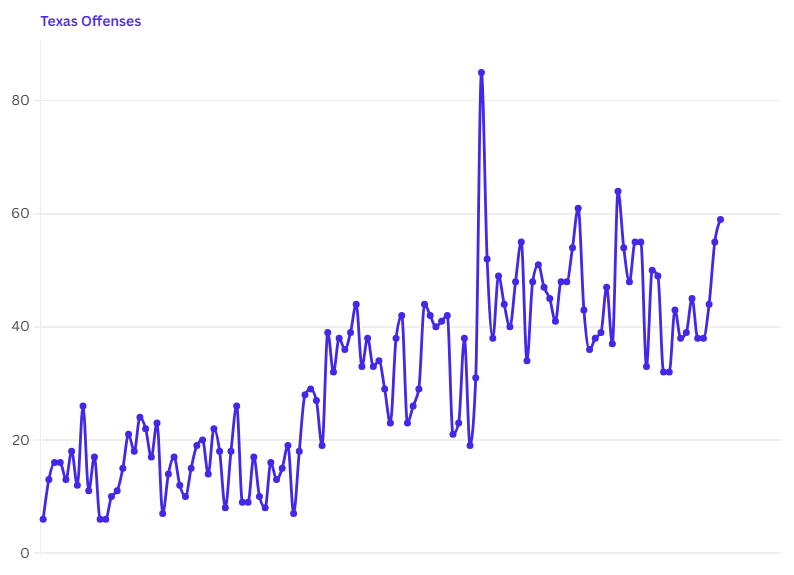
The first element of this project was to check CDE data to see the trends of hate crimes throughout the years. I chose Texas because as a native Texan (who grew up in Houston, one of the most diverse cities in Texas), I am naturally curious about the trends in my home state, as there are various perspectives that are represented there. The below graph represents the amount of hate crimes in the state of Texas from 2014 to 2024. Given the limitations of the visualization software, I was unable to properly represent the passage of time on this graph. However, each dot on the graph represents the reported hate crimes for that specific month and the Y-Axis represents the amount of hate crimes reported in that month.
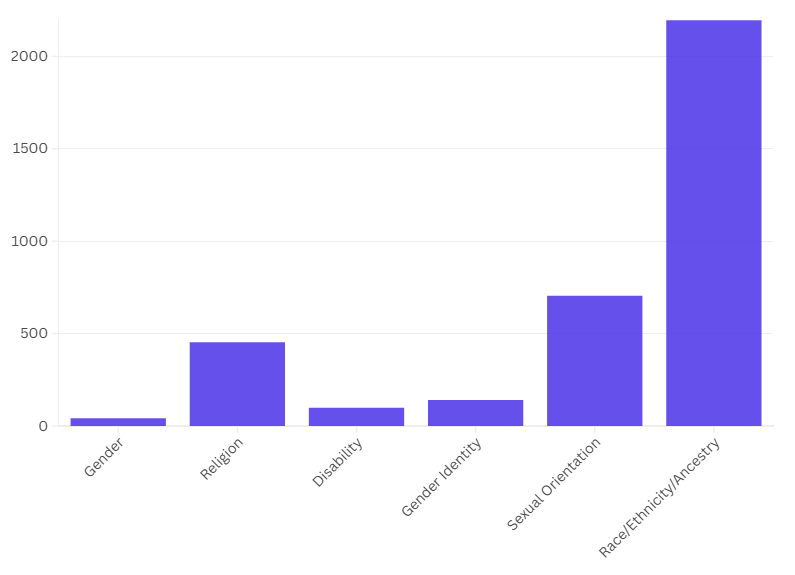
I then proceeded to categorize the different types of hate crimes committed in that timespan as well
Tracking Political Leanings in Texas
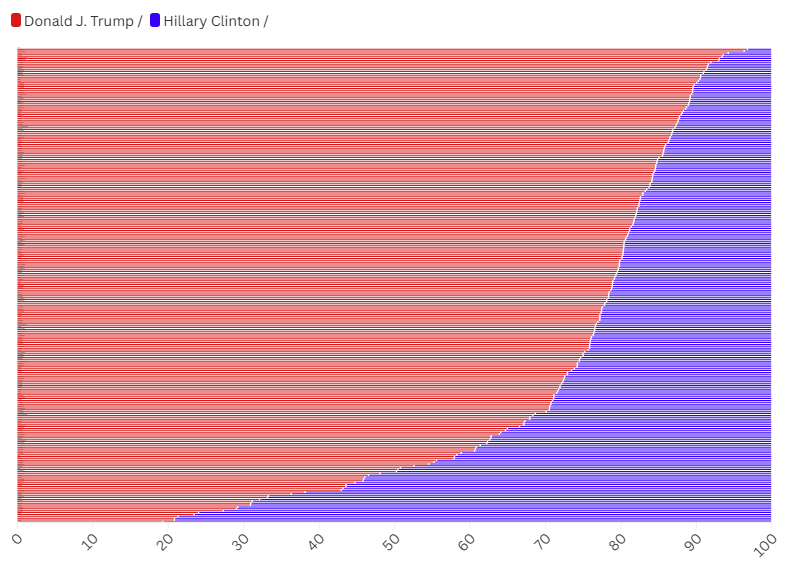
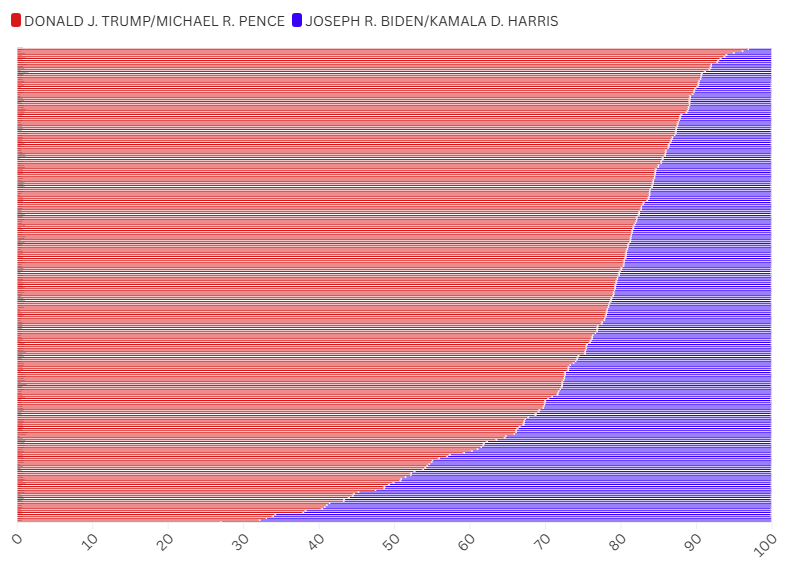
The nest step was to track voter statistics in the state of Texas for both 2016, the first Trump Presidency, and 2020, the Biden Presidency. I broke down the election results into the percentage of votes each candidate received in both elections. Again given the limitations of the visualization software and the number of counties in Texas, I was unable to create an accurate representation of the information I was able to gather. However, the graph below shows the percentage of votes each candidate received in the 2016 and 2020 elections, the X-Axis representing the percentage of votes received, and the Y-Axis representing each individual county in the state of Texas.
Analyzing Data
Based on the data I collected and comparing the political leanings of counties in Texas with data obtained from the OCR that counts the amount of hate crimes from 2014 to 2024 in Texas counties, I concluded that there is no discernable correlation between political leaning and the probability to commit a hate crime. However, I do consider this study incomplete. I say this because while the official statistics from the OCR do not have enough data to come to a decisive conclusion, there is hidden data that is more difficult to obtain. At the core of this study, I wanted to learn whether or not political alignment leads to violence based on the bias and propaganda that comes from political radicalization. However, violence comes in many forms. This study relied mostly on quantitative data and qualitative data that had been parsed through various legal channels. However, what cannot be quantified are the instances that do not get reported. This does not account for the microaggressions, intimidation and day-to-day racism that people of color, that may or may not have a voice experience on a daily basis. So while this study could not prove a correllation between political alignment and violence, I do consider this study incomplete due to a lack of the qualitative data that would add more context the quantitative data.
Technical Credits - CollectionBuilder
This digital collection is built with CollectionBuilder, an open source framework for creating digital collection and exhibit websites that is developed by faculty librarians at the University of Idaho Library following the Lib-Static methodology.
The site started from the CollectionBuilder-GH template which utilizes the static website generator Jekyll and GitHub Pages to build and host digital collections and exhibits.